Historic Milestone in the Middle Corridor: China-Türkiye-Europe Trains Arrive in Istanbul
The arrival of two freight trains in Istanbul marks a historic turning point for the China–Türkiye–Europe Railway Line, following the strategic cooperation agreement between Pasifik Eurasia and China Railway. The launch of regular freight operations along the Middle Corridor further strengthens Türkiye’s role in global logistics.
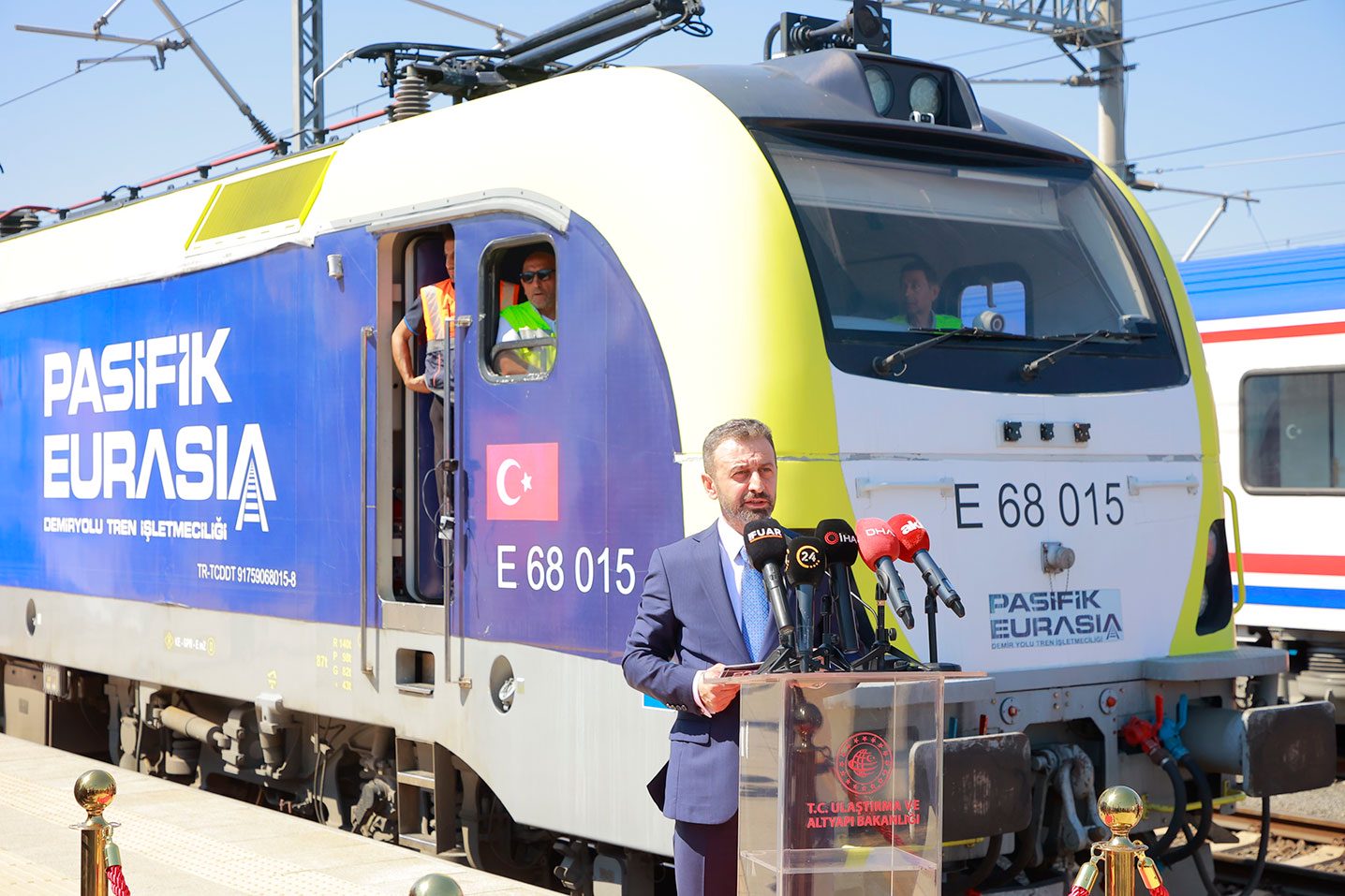
Under the agreement between Pasifik Eurasia—Pasifik Holding’s international logistics company—and China Railway, two freight trains that departed from China on July 9 arrived at Marmaray Halkalı Station in Istanbul after a 15-day journey. Each train, approximately 800 meters long, carried a total of 98 containers—55 from Chengdu and 43 from Chongqing. One of the trains will travel approximately 11,000 kilometers to Budapest, Hungary, while the other is bound for Łódź, Poland, covering a distance of 10,400 kilometers. A welcoming ceremony was held to commemorate this milestone, attended by Deputy Ministers of Transport and Infrastructure Enver İskurt and Osman Boyraz, and Pasifik Eurasia Vice Chairman of the Board Erol Erkan.
These rail services not only reinforce Türkiye’s east-west logistics hub status, but also mark a critical threshold for establishing a strategic trade corridor through regular freight transport.
“A New Era Begins in the Middle Corridor”
In his speech at the ceremony, Erol Erkan, Vice Chairman of Pasifik Eurasia, highlighted the strategic and regional significance of the new line:
“Today, we have entered a new era in the Middle Corridor via the China–Türkiye–Europe Railway Line. Since our founding in 2019 under the vision of the Iron Silk Road, Pasifik Eurasia has conducted numerous trial runs. During this process, we worked with countries along the route to address operational challenges and create action plans. Despite difficulties, we consistently emphasized the indispensable importance of the Middle Corridor for Türkiye. Today, we proudly welcome the first two freight trains from Chongqing and Chengdu, marking the beginning of a new chapter. This achievement is the result of our visionary strategy, the leadership of the Ministry of Transport and Infrastructure, the technical capabilities of TCDD and TCDD Taşımacılık A.Ş., and our partnerships with Chinese stakeholders. Multiple visits and meetings were held in China with the support of our Ministry. The fact that the trains completed their journey from the Chinese border to Istanbul in just 15 days is a powerful testament to our infrastructure, strategic position, and international collaboration.”
“Committed to Realizing the Middle Corridor’s Full Potential”
Erkan stated that Pasifik Eurasia focuses on railway logistics and aligns its goals with the Belt and Road Initiative:
“Our primary aim through this collaboration with China Railway is to accelerate the Belt and Road Initiative by advancing the Middle Corridor through Türkiye, thereby supporting economic growth across the region. With its rich heritage, reliability, sustainability, and time efficiency, the Middle Corridor presents a viable alternative to other trade routes. We are proud to be receiving the first China–Türkiye–Europe trains on this corridor as a result of our persistent efforts to unlock its strategic value.”
Türkiye Takes Its Place at the Heart of Global Freight
Highlighting Türkiye’s increasing role in global supply chains, Erkan noted:
“As you know, the Middle Corridor extends from China to Europe via Kazakhstan, the Caspian Sea, Azerbaijan, Georgia, and Türkiye. Beyond being an alternative trade route, this corridor offers Türkiye significant geographic and economic opportunities.”
Scaling Up the Middle Corridor
Erkan stated that the initial target is to operate 1,000 block train services annually along the Middle Corridor.
“At Pasifik Eurasia, we expect to reach this target in a short time and foresee exponential growth in the medium term. As of 2024, the Baku–Tbilisi–Kars (BTK) railway line has reached an annual capacity of 5 million tons. Furthermore, infrastructure projects such as Marmaray, Yavuz Sultan Selim Bridge, and the Northern Marmara Highway are expected to significantly enhance Türkiye’s transit capacity. These developments support both the country’s strategy to become a logistics hub and Pasifik Eurasia’s goal to lead the BTK and Middle Corridor.”
“Türkiye Is a Key Actor in the Middle Corridor”
Erkan concluded by emphasizing Türkiye’s vital role:
“Türkiye is more than a transit country on this route—it is one of the most critical links. Just as China, as the cargo origin, defines the starting point of the route, Türkiye plays a pivotal role as the preferred logistics distribution center. With this awareness, we continue our efforts to strengthen the Middle Corridor and expand its logistics capacity. Seeing the results of our long-term work is a great source of pride and inspiration for Pasifik Eurasia.”