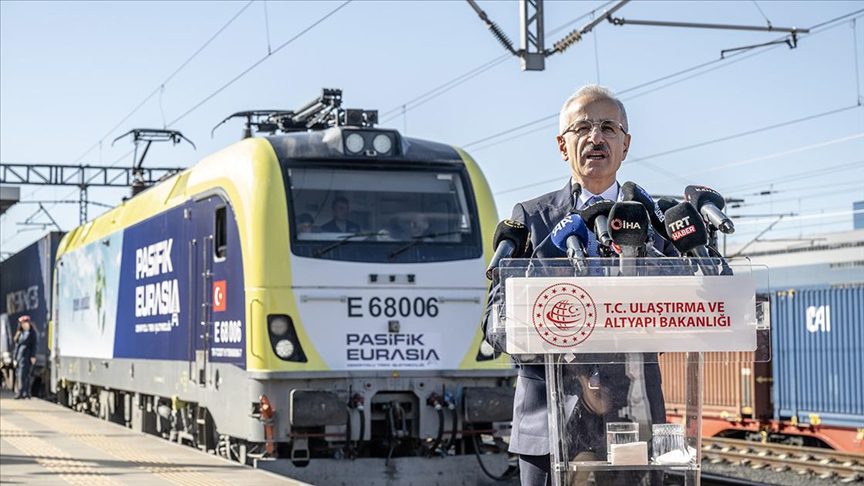
Pasifik Eurasia DTI plans to transport 750,000 tons of export cargo worth 600 million euros annually
During the ceremony, Minister Abdulkadir Uraloğlu stated that by becoming Türkiye’s third and the first international freight railway train operator, Pasifik Eurasia has reached a major milestone for the development of the industry. The Minister noted that the export train operating on the Istanbul–Budapest route will travel 278 km in Türkiye, 406 km in Bulgaria, 634 km in Romania and 231 km in Hungary, totaling 1,549 km, and the journey will be completed in four days. Minister Uraloğlu said, “Operating on this route, Pasifik Eurasia plans to run 60 trains monthly and 600 trains annually, transporting 750,000 tons of export cargo valued at 600 million euros—the equivalent of 22,000 trucks.”
Minister Uraloğlu emphasized that Türkiye had a railway sector that was nearly forgotten for almost half a century. “Between 1951 and 2004, only 945 kilometers of railway were built. To liberalize the sector, numerous measures had to be taken, legal barriers had to be removed and a strong railway infrastructure had to be allocated. Under the leadership of our President, we adopted railways as a state policy and declared it a priority sector. Since 2003, we added nearly 3,000 kilometers to our network—2,250 kilometers being high-speed and rapid rail lines—bringing the total to 13,919 kilometers.”
The Silk Road Has Become the Iron Silk Road
Minister Uraloğlu noted that the Iron Silk Road, regarded as the safest, shortest, most economical and climate-friendly railway corridor between Asia and Europe, is one of the international efforts they value most. “Centuries ago, silk threads produced by silkworms were the most valuable cargo carried along the Silk Road from China to Europe. Today, instead of silk, containers travel along this historic route. Inside these containers are not only consumer goods, but raw materials and even new hopes that will shape a new world order. Revitalizing this ancient trade route, the iron pathways—the railways—form the new Silk Road between China and Europe. That is why today we call it the ‘Iron Silk Road.’”
He highlighted that 9,340 train services from China to Europe and 8,180 from Europe to China operated in 2023, transporting 1.9 million TEU of cargo. Minister Uraloğlu added, “As a country forming a bridge between Asia and Europe, Türkiye has launched a new era in rail freight to turn this geographical advantage into economic and commercial value. To capture a greater share of this traffic, the Baku–Tbilisi–Kars Railway Line, which began operations in October 2017, has provided new direction for rail transport. Containers travel from China to Türkiye in 12 days and from China to Europe in 18 days via the Marmaray Tunnel. The first train between China and Türkiye reached Prague in 18 days in October 2019. Since then, block container trains have continued operating between Türkiye and China. Since its opening, the BTK line has carried 67,281 TEU and over 1.5 million tons including conventional cargo. These volumes will increase further.”
We Aim to Reduce China–Türkiye Transport Time to 10 Days
Minister Uraloğlu announced their targets for the Middle Corridor and BTK route: “In the medium term, we aim to operate 200 block trains annually, and in the long term 1,500 block trains. Our goal is to reduce the China–Türkiye transport time from 12 days to 10 days.”
He also noted that the Yavuz Sultan Selim Bridge rail project—one of the most strategic routes in the Development Road Project—has drawn major interest from international credit institutions, especially the World Bank. He stated that they aim to begin construction in early 2025. He added: “With our ongoing projects and those in planning, we aim to expand Türkiye’s railway network to 17,287 km by 2028 and 28,590 km by 2053. In line with our national transport and logistics master plan, we aim to reduce the share of road transport from 72% to 57%, while increasing the share of rail freight from 5% to 22%. We plan to raise our annual rail freight volume from 32 million tons to 448 million tons.”
Minister Uraloğlu emphasized the importance of private-sector operators entering the railway market: “We will not expect everything from the state anymore. Private operators will also take responsibility for growing the railway sector. Together, we will build a stronger industry. I hope the Istanbul–Budapest service launched today by Pasifik Eurasia marks the beginning of many more journeys.”
Istanbul Governor Davut Gül also thanked the President, Türkiye’s institutions and the Pasifik Eurasia team for enabling this significant opportunity for exporters.
We Have Expanded Türkiye’s Railway Network to 14,000 Kilometers
TCDD Director General Veysi Kurt emphasized major advancements in the rail sector over the past 22 years: “Under the leadership of our President, Türkiye’s railway network has grown from nearly 10,000 kilometers to almost 14,000 kilometers.” Highlighting Türkiye’s leap in high-speed train operations, Kurt said, “We rose from a country with no high-speed trains to sixth place in Europe and eighth in the world.” He also emphasized that Türkiye now produces its own rails, wheels, wagons and locomotives, moving away from complete import dependency. Kurt added, “We have transitioned from a monopoly to a competitive market where both public and private companies operate. Pasifik Eurasia’s new service is extremely important—it will support efficient use of our railway capacity and strengthen Türkiye’s foreign trade.”
Our Transportation Capacity in Europe Will Increase by 50%
Pasifik Eurasia Chairman F. Nusret Dur stated that Pasifik Eurasia DTI’s launch of services from Halkalı to Budapest is a significant step supporting Türkiye’s ambition to become a logistics hub. Dur described the first train as consisting of 19 wagons, weighing 1,250 tons and measuring 550 meters in length. “The train carries 16 trailers, 10 swap bodies and 12 tank containers, equivalent to 38 trucks of export cargo. These services will contribute greatly to Türkiye acting as a logistics bridge and will significantly increase our business volume. In the short term, our goal on the Europe line is to expand our transport capacity by 50% and increase our weekly train frequency from 10 to 15,” he said.
Dur also highlighted the shift toward environmental sustainability: “Rail transport is now considered more environmentally friendly than other modes thanks to technological advances and Türkiye’s infrastructure investments. As Pasifik Eurasia, we are committed to sustainable transport. We obtained the Green Logistics Certificate in January 2024. Our goal is to minimize our carbon footprint and support a greener future. These new train services form a key part of this vision.”
Dur added that Pasifik Eurasia has achieved many firsts since entering the logistics sector in 2019, including China–Türkiye, Türkiye–China and Türkiye–Russia block trains. “We made significant investments and partnerships to enable seamless rail operations from Central Asia and China to Türkiye and onward to Europe. We signed major cooperation agreements in Germany, Hungary and Slovakia. We also established a company infrastructure in Europe to provide fully integrated door-to-door logistics solutions,” he said.